
Prayer for the Dead: All Souls' Day and praying for someone buried far away
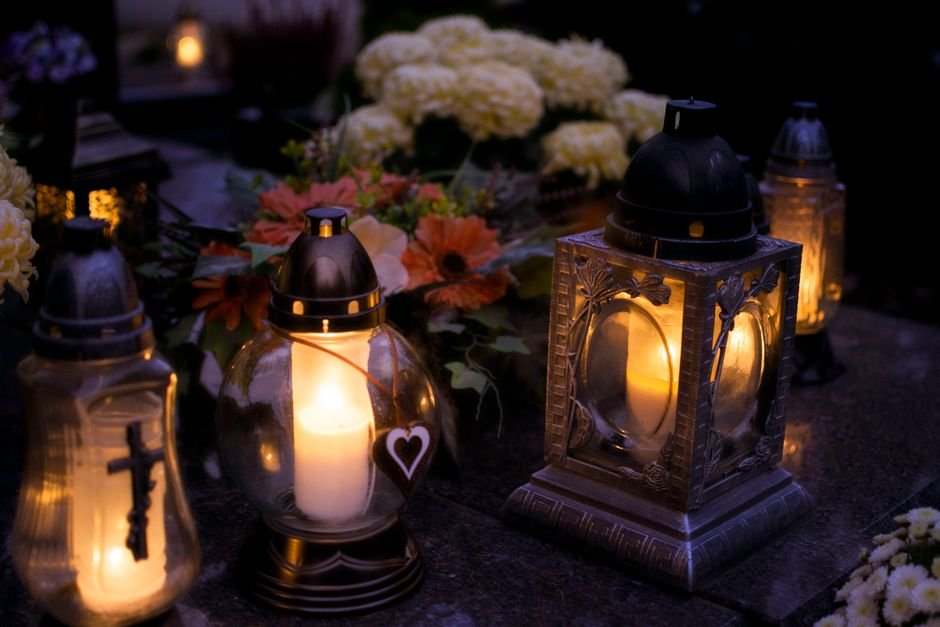
Praying for the dead is one of the oldest things Catholics do. Nobody needs it explained when the person who died is theirs.
This page has the prayers in English and Spanish, what November 1 and 2 actually are, and how to pray them — including for someone buried in another country, which for a lot of families here is the whole problem.
- November 1 and November 2 are not the same day
- The prayers you'll need
- The Eternal Rest prayer (Requiem aeternam)
- How to pray for someone who died
- Prayer for a family member who died
- Prayer for someone who died far from home
- Prayer for the souls in purgatory
- Out of the depths: Psalm 130 (De Profundis)
- The novena: nine days to November 2
- A short litany for the holy souls
- Día de Muertos and the faith
- Day of the Dead prayers: what to say at the ofrenda
- Visiting the cemetery, and the indulgence
- Praying for someone who wasn't Catholic, or who died badly
- Death anniversaries, and the month's mind
- Frequently asked questions
November 1 and November 2 are not the same day
November 1 is All Saints' Day. It honors everyone already in heaven — the canonized saints and, just as much, the ordinary people who got there without anyone writing it down. In the United States it's a holy day of obligation in most years.
November 2 is All Souls' Day, el Día de los Fieles Difuntos. That's the day for praying for everyone who has died, that God complete whatever still needs completing in them.
The first is thanksgiving. The second is intercession. Most families keep them as one long remembrance across both days, which is fine.
The prayers you'll need
These devotions are built out of a few short prayers. If you heard them in Spanish growing up and never learned them in English, here are both. Pray in whichever language is actually yours.
The Sign of the Cross
In the name of the Father, and of the Son, and of the Holy Spirit. Amen.
En el nombre del Padre, y del Hijo, y del Espíritu Santo. Amén.
The Our Father
Our Father, who art in heaven, hallowed be thy name; thy kingdom come; thy will be done on earth as it is in heaven. Give us this day our daily bread, and forgive us our trespasses, as we forgive those who trespass against us; and lead us not into temptation, but deliver us from evil. Amen.
The Hail Mary
Hail Mary, full of grace, the Lord is with thee. Blessed art thou among women, and blessed is the fruit of thy womb, Jesus. Holy Mary, Mother of God, pray for us sinners, now and at the hour of our death. Amen.
The Glory Be
Glory be to the Father, and to the Son, and to the Holy Spirit. As it was in the beginning, is now, and ever shall be, world without end. Amen.
A decade means one Our Father, ten Hail Marys and one Glory Be. If nobody ever explained that term to you, that's all it is.
The Eternal Rest prayer (Requiem aeternam)
If someone tells you to "say a prayer for the eternal repose of his soul," this is the one they mean. It is four lines long, it is the oldest thing in this page, and it is what priests say at the graveside when everyone else has run out of words.
Eternal rest grant unto them, O Lord,
and let perpetual light shine upon them.
May they rest in peace.
Amen.
In Spanish, the way your grandmother would have said it:
Dales, Señor, el descanso eterno,
y brille para ellos la luz perpetua.
Que descansen en paz.
Amén.
And in Latin, which is the version carved on a lot of older headstones — worth recognizing if you have ever stood in front of one and wondered: Requiem aeternam dona eis, Domine, et lux perpetua luceat eis. Requiescant in pace. Amen.
It is often prayed as a call and answer, one person leading and the rest responding. If you are praying with family, give the first two lines to one person and let everyone else answer with the last two. That is how it is meant to sound, and it is why it sticks in people's memory for fifty years.
You can say it for one person by name — eternal rest grant unto him, unto her — or for everyone at once. There is no wrong number of times to repeat it.
How to pray for someone who died
Praying for someone who died, step by step
- Light a candle. Put out their photograph if you have one.
- Make the Sign of the Cross.
- Say their name out loud. The whole name.
- Pray the prayer for a family member who died, below.
- Pray one decade: one Our Father, ten Hail Marys, one Glory Be.
- Close with the responsory: Eternal rest grant unto them, O Lord, and let perpetual light shine upon them. May they rest in peace. Amen.
- Make the Sign of the Cross again.
At the cemetery, do the same thing standing at the grave and skip the candle. If you only have a minute, the eternal rest prayer alone is complete.
Prayer for a family member who died
Lord, you have taken [name] from us, and we don't fully understand it. Receive them. Forgive whatever needs forgiving, and remember everything they did well that nobody saw. Give them the rest they didn't get much of here. And give us, who are still going, the grace to live in a way we'd be glad to meet them with. Eternal rest grant unto them, O Lord, and let perpetual light shine upon them. Amen.
Señor, te has llevado a [nombre] y no acabamos de entenderlo. Recíbelo. Perdona lo que haya que perdonar y recuerda todo lo bueno que hizo sin que nadie lo viera. Dale el descanso que aquí tuvo poco. Dales, Señor, el descanso eterno, y brille para ellos la luz perpetua. Amén.
Prayer for someone who died far from home
Lord, they were buried where I couldn't be. The distance that kept me from the funeral is still here, and the guilt with it. You were in that church and at that graveside when I couldn't be, and you are here with me now. Carry my prayer to where their body lies. Tell them, in whatever way the dead are told, that they were not forgotten — that I think about them on the drive to work and when I can't sleep. Give rest to them, and give me peace about what I couldn't do. Amen.
For someone buried in another country
- Set out their photograph, and if you have one, something from where they're buried.
- Make the Sign of the Cross and say their name.
- Pray the prayer for someone who died far away, below.
- One decade.
- Call whoever is there — a sibling, a cousin — and pray part of it with them on the phone. Praying at the same hour from two countries is still praying together.
- The responsory, and the Sign of the Cross.
If you can't travel to the grave, you have not failed them. The Church has never taught that prayer for the dead requires being in a particular place.
Prayer for the souls in purgatory
Merciful God, remember the souls who have no one left to pray for them: the ones whose families are gone, whose names are off the headstones, who died alone or among strangers or on the road. No one lights a candle for them. Let this prayer count for them. Eternal rest grant unto them, O Lord. Amen.
Out of the depths: Psalm 130 (De Profundis)
When the Church prays for the dead at length — at a funeral, at a month's anniversary, in the Office of the Dead — it reaches for this psalm. It has been the prayer for the dead for about two and a half thousand years, which is longer than there have been Catholics.
Out of the depths I cry to you, O Lord;
Lord, hear my voice.
Let your ears be attentive to my voice in supplication.
If you, O Lord, mark our iniquities, Lord, who can stand?
But with you is forgiveness, that you may be revered.
I trust in the Lord; my soul trusts in his word.
My soul waits for the Lord more than sentinels wait for the dawn.
For with the Lord is kindness and with him is plenteous redemption;
and he will redeem Israel from all their iniquities.
Amen.
It is called the De Profundis after its first two words in Latin. The reason it works for grief, and the reason it has outlasted everything else, is in the fourth line: it does not pretend the dead were perfect, and it does not pretend you are. It asks for mercy on both of you at once.
Traditionally it is followed by the Eternal Rest prayer. That pairing — psalm, then responsory — is the whole structure of praying for the dead in the Latin Church, and you now know it.
The novena: nine days to November 2
To finish on All Souls' Day, start on October 25. Each day is the same shape — candle, name, prayer, one decade, the responsory — and many families give each day a different person: a parent, a grandparent, someone who died young, someone nobody else remembers.
A short litany for the holy souls
The holy souls or poor souls — both are normal English for the dead who are being prayed for — have their own litany. The full one is long. This is the part families actually use, said with one person leading and everyone answering pray for them or have mercy on them.
Lord, have mercy on them.
Christ, have mercy on them.
Holy Mary, Mother of God — pray for them.
Saint Joseph, patron of a happy death — pray for them.
All you holy men and women — pray for them.
From every stain of sin — deliver them, O Lord.
By your cross and passion — deliver them, O Lord.
For our parents and grandparents — we pray to you, Lord.
For those who have no one left to pray for them — we pray to you, Lord.
Eternal rest grant unto them, O Lord, and let perpetual light shine upon them. Amen.
That second-to-last line is the one worth keeping. Every graveyard has people in it whose whole family is also in it, and nobody says their names anymore. Saying that line once a year covers all of them.
Día de Muertos and the faith
If you grew up here, you may have been told by someone that the altar is pagan, or morbid, or worse. It's worth knowing what it actually is.
The ofrenda — the photographs, the bread, the marigolds, the food they liked — is not worship of the dead. It's remembrance, set in the same days the Church already devotes to the dead. Mexican families have kept it alongside Mass, not instead of Mass, for centuries. UNESCO recognized the tradition as intangible cultural heritage in 2008.
The one distinction worth keeping clear: Catholics pray for the dead and ask the saints to pray with them. They don't worship either. The altar is a photograph on a table, not an act of worship.
Day of the Dead prayers: what to say at the ofrenda
This is the part nobody writes down. Families build the altar every year, and then stand in front of it not knowing whether they are supposed to say something out loud or just look at the photographs.
You are allowed to say something. Here is what it usually is.
You will see the days written three ways — Dia de los Muertos without the accents, Día de los Muertos with them, and Day of the Dead in English. They are the same two days, and nobody is keeping score about the spelling.
During Día de los Muertos — Day of the Dead, which runs from the night of October 31 through November 2 — the altar is where the praying happens, the same way a bedside is where you pray when someone is sick. The cempasúchil, the marigolds, are there because the color and the smell are supposed to help them find the way. The pan de muerto and the food are there because you fed them when they were alive and you are not going to stop now. The water is for the thirst of the journey, the salt so they are not corrupted on the way, the candle so there is a light on.
Praying at the altar, step by step
- Light the candle first, before anything is said. If there are several photographs, one candle for all of them is enough.
- Make the sign of the cross and say, out loud, the name of each person on the altar. Just the name. This is the part that undoes people, and it is the part that matters most.
- Say the Eternal Rest prayer — the one above, in whichever language it comes to you in. If there are children present, have them answer the second half.
- Say one Our Father and one Hail Mary for all of them together. If you want to pray a full decade, this is where it goes.
- Tell them one thing. Out loud or not. Something that happened this year that they would have wanted to know about. This is not a required part of any rite; it is what families actually do, and there is nothing wrong with it.
- Thank God for the time you had with them, which is the only part of the whole thing that is strictly about faith rather than about grief, and finish with the sign of the cross.
If someone in the family has died this year, their name goes first and the candle for them stays lit the longest. That is custom, not rule — but keep it, because it tells the newest grief in the house that it has been noticed.
You do not have to do it in Spanish for it to count, and you do not have to do it in English either. Most families end up mixing both in the same breath, which is exactly what the house sounded like when the people on the altar were still in it.
Visiting the cemetery, and the indulgence
From November 1 through 8, the Church attaches a plenary indulgence to visiting a cemetery and praying for the dead, under the usual conditions — confession, Communion, and prayer for the Pope's intentions. In plain terms, the Church is applying the fruits of Christ's mercy to the person you're praying for.
If there is no grave you can reach, say so to God and pray anyway. The conditions are about your disposition, not your travel.
Praying for someone who wasn't Catholic, or who died badly
These are the questions people are actually afraid to ask out loud, usually about someone they loved very much. The short answer to all of them is that you can pray for this person, and the Church wants you to.
Someone who wasn't Catholic, or wasn't baptized, or had no religion at all. Pray for them. The Church has never taught that God's mercy is restricted to the people who were on a parish register. It teaches that Christ died for everyone and that God can save whomever he wills by paths that are his business and not ours. Nothing stops you praying for a parent who never went to Mass in his life.
Someone who took their own life. The Catechism is unusually gentle here, and it is worth knowing exactly what it says, because a lot of families have been told something crueler by someone with no authority to say it. It says that grave psychological disturbance, anguish, and fear of hardship can diminish the responsibility of the person who dies this way. And then it says, plainly, that we should not despair of their eternal salvation — that by ways known to him alone, God can provide the opportunity for repentance. The Church holds funerals for them. Pray for them like you would for anyone.
An unbaptized baby, a miscarriage, a stillbirth. There is no teaching that condemns these children, and the idea of limbo was never defined doctrine — it was a theological opinion that the Church has let go of. What the Catechism actually does is entrust them to the mercy of God, and in 2007 a Vatican commission published a document whose entire subject was the hope of their salvation. If your child had no name said over them, you can give them one now, and pray for them under it.
Someone you were not on speaking terms with when they died. Pray for them anyway. This is, historically, most of what praying for the dead has been for.
Death anniversaries, and the month's mind
Praying for the dead is not only a November thing, and the two dates most families keep are worth naming because they have names.
The month's mind is a Mass or a prayer said about a month after the death. It exists because the first month is when everyone else goes back to normal and the family does not, and it is a way of saying out loud that the person is still being carried.
The anniversary — the cabo de año in a lot of Mexican families, marking the first full year — is the other one. The custom is to have a Mass offered for them, and failing that, to say the Eternal Rest prayer and a decade at home on the date.
You can also ask your parish to offer a Mass for someone on any date you choose. It is normal, it is not expensive, and in most parishes you simply go to the office and ask. If you want to pray for them on a day that is nobody's feast and nobody's anniversary, for no reason except that you thought of them in the car, that counts too. It has always counted.
Frequently asked questions
What is the prayer for the dead called?
The short one is the Eternal Rest prayer, or the responsory: "Eternal rest grant unto them, O Lord…"
How many prayers do you say for a person who died?
There's no required number. The common pattern is the prayer plus one decade. Returning to it over nine days matters more than the count.
Do I need a candle or an altar?
No. They help you keep the habit; they aren't the prayer.
Can I pray for someone who wasn't Catholic?
Yes. You can pray for anyone who has died. God's mercy isn't limited to the people whose paperwork was in order.
What if I can't get to the grave?
Pray where you are. Nothing in Catholic teaching ties prayer for the dead to standing in a specific place.
What's the difference between All Saints and All Souls?
November 1 honors those already in heaven. November 2 prays for all who have died.
The Spanish version of this page is here. There is also a full rosario de ánimas in Spanish, the rosary Mexican families pray for the souls on November 2.