
Prayer to St. Oscar Romero: March 24, the novena and how to pray it
If your family is from El Salvador, there's a good chance someone at home called him Monseñor — not "Archbishop Romero," not "Saint Oscar," just Monseñor. He was the archbishop of San Salvador who spoke up for the poor during the worst years of the country's violence, and who was shot at the altar while celebrating Mass on March 24, 1980. In 2018 he became El Salvador's first canonized saint.
This page has prayers to St. Oscar Romero in English and in Spanish, how to pray them at home, the novena that ends on his feast day, and his story. It also clears up something most English-language pages get wrong: the famous "Oscar Romero prayer" that circulates online isn't his.
- Prayer to St. Oscar Romero
- How to pray to St. Oscar Romero
- Prayer for justice and peace
- Prayer for family back home
- A short prayer to St. Oscar Romero
- The novena to St. Oscar Romero: March 16 to 24
- Who St. Oscar Romero was
- March 24, 1980
- From martyr to saint
- March 24 in the United States
- The "Oscar Romero prayer" he didn't write
- "If they kill me, I will rise again in the Salvadoran people"
- Frequently asked questions
Prayer to St. Oscar Romero
This is the main prayer. You can pray it any day of the year, and especially on March 24 and during his novena.
St. Oscar Romero, shepherd and martyr, you loved your people enough to give your life for them. Look at me today with the same tenderness you had for the poor of your country. You were not afraid to tell the truth, even when it cost you everything: ask God to give me the courage to live honestly and the faith not to give up when things get hard. I bring you this need [say your intention] and ask you to place it before the Lord you served to the end. May His will be done, and may I have the grace to recognize it. Amen.
San Óscar Romero, pastor y mártir, tú que amaste a tu pueblo hasta dar la vida por él, mírame hoy con la misma ternura con que mirabas a los pobres de tu tierra. Tú que no tuviste miedo de decir la verdad, aunque te costara la vida, alcánzame de Dios la valentía para vivir con honradez y la fe para no rendirme cuando las cosas se ponen difíciles. Te presento esta necesidad [di aquí tu petición] y te pido que la lleves ante el Señor, a quien serviste hasta el final. Que se haga su voluntad, y que yo sepa reconocerla. Amén.
How to pray to St. Oscar Romero
There's no official formula. This is the simple way many Salvadoran families pray to him at home, built from the ordinary pieces of Catholic prayer. If you grew up hearing these prayers in Spanish and never learned them in English, either language is fine.
Praying to St. Oscar Romero, step by step
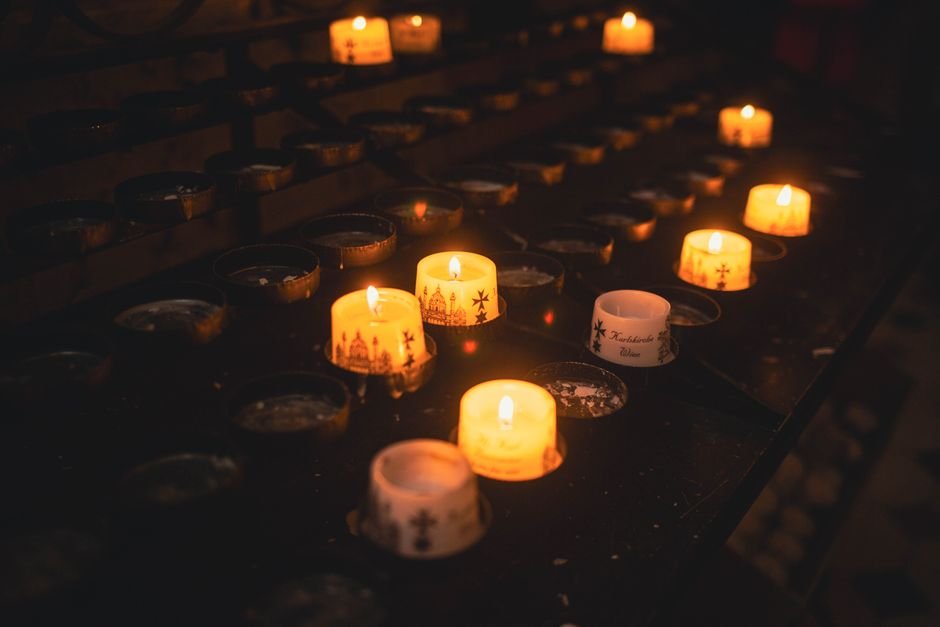
- Find a quiet moment. If you have a picture of Monseñor, put it in front of you. Many people light a white or red candle; red is the color the Church uses for martyrs.
- Make the Sign of the Cross: in the name of the Father, and of the Son, and of the Holy Spirit.
- Say your intention out loud, in your own words, and name the people you're praying for.
- Pray the prayer to St. Oscar Romero above, or whichever prayer on this page fits what you're asking.
- One Our Father, one Hail Mary and one Glory Be.
- Close with the invocation, three times: St. Oscar Romero, shepherd and martyr, pray for us — San Óscar Romero, pastor y mártir, ruega por nosotros.
- Make the Sign of the Cross again.
On March 24, if you can, go to Mass. He died celebrating it, and for the people who love him there's no closer way to remember him.
Prayer for justice and peace
Romero lived through El Salvador's darkest years, when violence reached into homes and churches. Many people pray to him for peace, for the victims of violence, and for families still waiting for justice.
St. Oscar Romero, you saw your people suffer and you did not stay silent. Intercede for everyone who lives in fear today: for families who lost someone to violence, for those still waiting for justice, for those who had to leave their homes. Ask God to touch the hearts of the violent and to strengthen those who work for peace. Let no tear be lost before Him. Amen.
San Óscar Romero, tú que viste sufrir a tu pueblo y no callaste, intercede por todos los que hoy viven con miedo: por las familias que perdieron a alguien por la violencia, por los que siguen esperando justicia, por los que tienen que huir de su casa. Pide a Dios que toque el corazón de los violentos y que dé fortaleza a los que trabajan por la paz. Que ninguna lágrima se pierda ante Él. Amén.
Prayer for family back home
About two and a half million people of Salvadoran origin live in the United States. This prayer is for anyone living far from where their family comes from — or for anyone praying for a parent, a brother or a child who left.
St. Oscar Romero, shepherd of the Salvadoran people, stay with those of us who live far from our land and with those who stayed behind waiting for us. Watch over [name] on the road and at work; may they never lack bread or dignity, and may they never feel alone. Keep our family together even when borders separate us, and, if it is God's will, let us be together again. Amen.
San Óscar Romero, pastor de los salvadoreños, acompaña a los que vivimos lejos de nuestra tierra y a los que se quedaron esperándonos. Cuida a [nombre] en el camino y en el trabajo; que no le falte el pan ni la dignidad, y que nunca se sienta solo. Mantén unida a nuestra familia aunque nos separen las fronteras, y concédenos, si es la voluntad de Dios, volver a reunirnos. Amén.
A short prayer to St. Oscar Romero
For a hard moment, for the drive to work, or to repeat during the day:
St. Oscar Romero, shepherd and martyr, pray for me and for the people I love. Amen.
San Óscar Romero, pastor y mártir, intercede por mí y por los míos. Amén.
The novena to St. Oscar Romero: March 16 to 24
To finish the novena on his feast day, start on March 16. Each day, pray the main prayer, one Our Father, one Hail Mary and one Glory Be, and remember one part of his life with that day's intention:
- March 16 — The faith of Ciudad Barrios. For families who pass the faith on to their children, as his did to him.
- March 17 — The calling. For priests, that they stay close to their people.
- March 18 — The priest of San Miguel. For everyone who works quietly, without anyone noticing.
- March 19 — Rutilio Grande. For the friends who change our lives, and for those who die defending others.
- March 20 — The voice of the voiceless. For the poor, the sick and those nobody listens to.
- March 21 — The truth. For catechists, journalists and everyone who tells the truth at a cost.
- March 22 — Those who left. For migrants and for families separated by distance.
- March 23 — "Stop the repression." For peace, and for the victims of violence.
- March 24 — The altar. For the Church, that it remains a home for the poor. If you can, go to Mass that day.
Who St. Oscar Romero was
Óscar Arnulfo Romero y Galdámez was born on August 15, 1917, in Ciudad Barrios, in eastern El Salvador, to a modest family. As a boy he was apprenticed to a carpenter, but he entered the seminary young, studied in Rome and was ordained a priest there in 1942, in the middle of the Second World War.
For more than twenty years he was a priest in San Miguel — pastor, diocesan secretary and a well-known preacher. He was made a bishop in 1970 and, in February 1977, archbishop of San Salvador. Many saw it as a safe choice: he had a reputation as conservative, shy and uncomfortable with conflict.
That changed within weeks. On March 12, 1977, his friend Fr. Rutilio Grande, a Jesuit, was murdered along with an old man and a teenage boy who were traveling with him. Romero spent the night beside their bodies, and from then on he preached like a shepherd who could no longer look away. His Sunday homilies, broadcast on the archdiocese's radio station, were heard across the country. He read out the names of the week's disappeared and murdered, and defended the farmworkers, catechists and priests being persecuted. People called him "the voice of the voiceless."
March 24, 1980
On Sunday, March 23, 1980, in his last homily, Romero spoke directly to the soldiers and police:
«En nombre de Dios, pues, y en nombre de este sufrido pueblo, cuyos lamentos suben hasta el cielo cada día más tumultuosos, les suplico, les ruego, les ordeno en nombre de Dios: ¡Cese la represión!»
"In the name of God, then, and in the name of this suffering people, whose cries rise to heaven more loudly every day, I beg you, I implore you, I order you in the name of God: stop the repression!"
The next day he was celebrating a Mass for a friend's mother in the small chapel of the Hospital de la Divina Providencia, a cancer hospital where he lived. As he finished the homily and the offertory was about to begin, a sniper shot him from the chapel doorway. He died at the altar. He is buried in the crypt of the Metropolitan Cathedral of San Salvador.
From martyr to saint
In February 2015, Pope Francis recognized that Romero had been killed out of hatred for the faith — that he was a martyr — and on May 23, 2015, he was beatified in San Salvador. A later healing, of a Salvadoran woman who was gravely ill after giving birth, was approved as a miracle.
On October 14, 2018, in St. Peter's Square, Pope Francis canonized him together with Pope Paul VI. For the ceremony, Francis wore the bloodstained cincture Romero had on the day he was killed.
March 24 in the United States
Wherever there are Salvadoran communities — Los Angeles, the Washington area, Houston, New York — it's common to find Spanish Masses in his honor on March 24, sometimes with the blue-and-white flag beside the altar. If your parish has a Hispanic ministry, ask; it's often the easiest way to find one.
His memory reaches beyond the Catholic Church. In 2010 the United Nations proclaimed March 24 the International Day for the Right to the Truth concerning gross human rights violations and for the dignity of victims, in his honor. And in London his statue stands on the west front of Westminster Abbey, among ten martyrs of the twentieth century placed there in 1998.
The "Oscar Romero prayer" he didn't write
Search for "Oscar Romero prayer" and you'll find, almost everywhere, a reflection that begins: "It helps, now and then, to step back and take a long view." It's often called Prophets of a Future Not Our Own or A Step Along the Way, and it ends with the line "We are prophets of a future not our own."
Romero didn't write it. It was written in 1979 by Ken Untener, later bishop of Saginaw, Michigan, as part of a homily for Cardinal John Dearden of Detroit. Over the years it became attached to Romero's name because it sounds like him. It's a good prayer, and there's nothing wrong with praying it — just know whose words they are. Romero's own words are in his homilies, which were recorded and have been published in full.
"If they kill me, I will rise again in the Salvadoran people"
This is the line most often quoted from him, and it deserves care. It comes from an interview with a journalist, published after his death, said to have taken place a few weeks before he was killed. It isn't in his homilies or writings, and historians debate whether he said it in those exact words.
What is documented is that he knew his life was in danger and he didn't leave. He had received threats and kept preaching every Sunday. Whether or not he said it that way, the line sums up what his people saw in him.
Frequently asked questions
When is St. Oscar Romero's feast day?
March 24, the anniversary of his death in 1980. To end the novena that day, start it on March 16.
Why was he killed?
Because he denounced the killings, disappearances and repression his people were suffering. In 2015 the Church recognized that he died out of hatred for the faith.
When was he canonized?
On October 14, 2018, in Rome, by Pope Francis. He had been beatified in San Salvador on May 23, 2015.
What do people ask St. Oscar Romero for?
Mostly justice and peace, protection for their families, courage in frightening moments, and help for migrants and the poor — the causes he gave his life for.
Where is he buried?
In the crypt of the Metropolitan Cathedral of San Salvador.
Why is he called "San Romero de América"?
It's the title his people gave him long before the official canonization, made popular by a poem Bishop Pedro Casaldáliga wrote shortly after his death.
The Spanish version of this page is here, with the same prayers and the novena — useful if you want to send it to someone in the family who prays in Spanish.