
Our Lady of Guadalupe Prayer: December 12, Las Mañanitas and how to pray to her
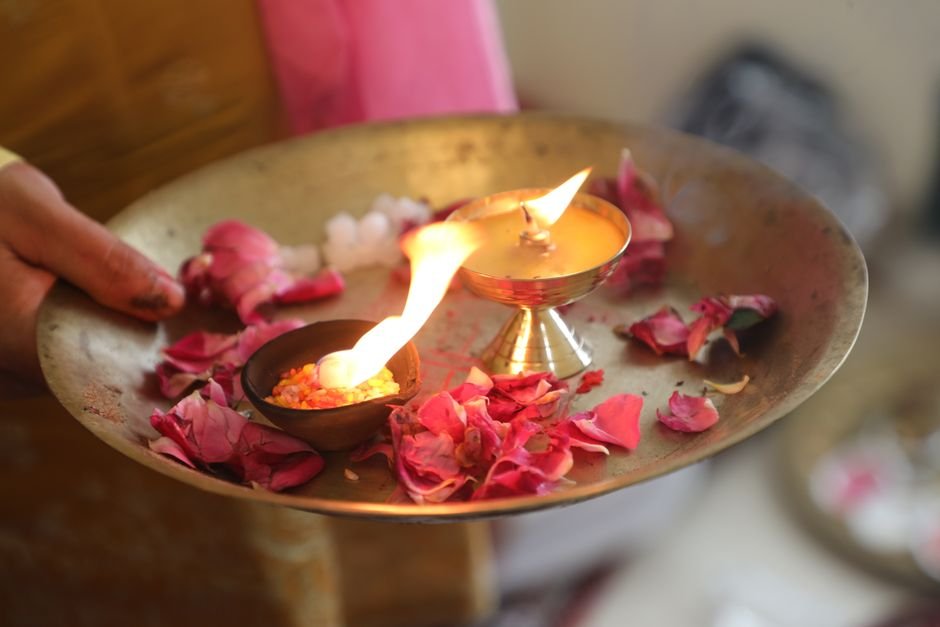
If your family is Mexican, you didn't learn about Our Lady of Guadalupe. You just always knew. She was on a candle in the kitchen, on a medal, on the wall behind the television.
This page has her prayers in English and in Spanish, what December 12 is and why it's sung at midnight, and how to actually pray to her — step by step, in case nobody ever walked you through it.
- Who she is
- Who Saint Juan Diego was
- The prayers you'll need
- How to pray to Our Lady of Guadalupe
- Prayer to Our Lady of Guadalupe
- Prayer for the family
- Prayer for December 12
- Novena to Our Lady of Guadalupe: December 3 to 11
- Patroness of the unborn: praying for a pregnancy
- December 12 in the United States
- December 8 and December 12 are not the same feast
- What Las Mañanitas is
- Why is she called Guadalupe?
- What the image means
- Frequently asked questions
Who she is
In December 1531, ten years after the fall of Tenochtitlan, an indigenous man named Juan Diego said a woman appeared to him on the hill of Tepeyac, outside what is now Mexico City. She spoke to him in Nahuatl, his own language, and called him the smallest of her children. She asked for a church to be built there.
The bishop wanted proof. On December 12 Juan Diego gathered roses that were blooming out of season, carried them in his tilma — the cloak indigenous men wore — and when he opened it before the bishop, the image was on the cloth. That cloak hangs today in the Basilica in Mexico City.
Two things are worth saying plainly. The Church promotes this devotion and canonized Juan Diego on July 31, 2002. But the apparitions are private revelation: no Catholic is required to believe in them. And among historians there's a real, open debate about the sources. Both things are true at once.
Who Saint Juan Diego was
She did not appear to a bishop or to a Spaniard. She appeared to a middle-aged indigenous man who was walking to Mass, and that is the whole point of the story.
His name was Cuauhtlatoatzin, which is usually translated as "eagle that speaks." He was born around 1474 in Cuauhtitlán, north of what is now Mexico City, and he was Chichimec — one of the peoples the Spanish had just conquered. He was baptized as Juan Diego by Franciscan missionaries in the mid-1520s, in his fifties, which means he spent most of his life in the old religion and converted as a grown man.
By December 1531 he was a widower. His wife, María Lucía, had died two years earlier. He lived with his uncle Juan Bernardino, farmed a small plot, and walked several hours each way to catechism. He was, in every sense that mattered to the society around him, nobody.
When the bishop refused him the first time, the account says he asked the Virgin to send somebody important instead, because he was "a nobody, a small rope, a tiny ladder." She sent him back. That exchange is why the story landed the way it did with the indigenous population: the Mother of God had been offered a Spaniard and had asked for the Indian.
After 1531 he spent the rest of his life beside the chapel on the Tepeyac, looking after it and telling what he had seen. He died in 1548. Saint John Paul II beatified him in 1990 and canonized him on July 31, 2002, in Mexico City. His feast day is December 9, the day of the first apparition — which is why it falls inside the novena.
The prayers you'll need
These devotions are built out of a few short prayers. If you heard them in Spanish growing up and never learned them in English, here are both. Pray in whichever language is actually yours.
The Sign of the Cross
In the name of the Father, and of the Son, and of the Holy Spirit. Amen.
En el nombre del Padre, y del Hijo, y del Espíritu Santo. Amén.
The Our Father
Our Father, who art in heaven, hallowed be thy name; thy kingdom come; thy will be done on earth as it is in heaven. Give us this day our daily bread, and forgive us our trespasses, as we forgive those who trespass against us; and lead us not into temptation, but deliver us from evil. Amen.
The Hail Mary
Hail Mary, full of grace, the Lord is with thee. Blessed art thou among women, and blessed is the fruit of thy womb, Jesus. Holy Mary, Mother of God, pray for us sinners, now and at the hour of our death. Amen.
The Glory Be
Glory be to the Father, and to the Son, and to the Holy Spirit. As it was in the beginning, is now, and ever shall be, world without end. Amen.
A decade means one Our Father, ten Hail Marys and one Glory Be. If nobody ever explained that term to you, that's all it is.
How to pray to Our Lady of Guadalupe
Praying to Our Lady of Guadalupe, step by step
- Light a candle if you have one, and put her image where you can see it.
- Make the Sign of the Cross.
- Greet her the way the story has her greet Juan Diego — as a mother. Say who you're praying for.
- Pray the main prayer below.
- Pray one decade: one Our Father, ten Hail Marys, one Glory Be.
- Close with: Santa María de Guadalupe, ruega por nosotros. Our Lady of Guadalupe, pray for us.
- Make the Sign of the Cross again.
On December 12 many families do this at midnight, when Las Mañanitas is sung. If you're working that night, the morning does just as well.
Prayer to Our Lady of Guadalupe
Our Lady of Guadalupe, mother of the Americas, you who appeared to Juan Diego and asked that your children be heard: look on me now. You said to him, "Am I not here, I who am your mother?" Let me believe that is said to me too. Take what I'm carrying into your hands and bring it to your Son. Watch over my family, the ones here and the ones far away. Keep me from losing heart. Amen.
Virgen de Guadalupe, madre de América, tú que te apareciste a Juan Diego y pediste que tus hijos fueran escuchados: mírame ahora. Tú le dijiste: «¿No estoy yo aquí, que soy tu madre?». Déjame creer que también me lo dices a mí. Cuida de mi familia, la que está aquí y la que está lejos. No dejes que pierda la esperanza. Amén.
Prayer for the family
Holy Mary of Guadalupe, you are the mother of this house. Hold it together. Where there is distance between us, close it. Where there is anger, cool it. Protect the ones who are far from home and the ones who can't come back yet. Keep the children in the faith they were baptized into, even when their lives look nothing like ours did. Amen.
Prayer for December 12
Blessed Mother of Guadalupe, on this your day I come to thank you before I ask for anything. Thank you for the year that's ending and for everyone who got through it. Receive the flowers, the songs and the Masses offered to you today across this country and in Mexico. Protect me and mine through the year that begins under your mantle. Amen.
Novena to Our Lady of Guadalupe: December 3 to 11
The usual way to prepare for December 12 is the novena: nine days of prayer that end the night before. To have it finish in time you start on December 3 and pray the ninth day on December 11, leaving the feast itself free.
Some people pray it ending on the 12th instead, starting the 4th. Either is fine. Parishes usually do the first, because it leaves the big day clear.
You pray the same prayer each day — any of the ones on this page — and change only the intention:
- Day 1 (Dec 3). For whoever in the family is sick, starting with the one you worry about most.
- Day 2 (Dec 4). For work: the job you have, the one you need, the pay that doesn't stretch.
- Day 3 (Dec 5). For your children, and for anyone raising them alone.
- Day 4 (Dec 6). For the family on the other side of the border, and for everyone waiting on papers.
- Day 5 (Dec 7). For the relatives who have stopped speaking to each other.
- Day 6 (Dec 8). For your own conversion. It is the feast of the Immaculate Conception, a holy day of obligation in the United States, so it fits to pray for whatever you want to leave behind.
- Day 7 (Dec 9). For your dead. It is the day Juan Diego first saw her.
- Day 8 (Dec 10). For the people who are suffering quietly and have told nobody.
- Day 9 (Dec 11). In thanksgiving for the year, asking for nothing.
If you miss a day, go on to the next one. You do not start over.
Patroness of the unborn: praying for a pregnancy
In the United States you will often hear her called the patroness of the unborn, and there is a reason for it that goes back to the image itself.
The figure on the tilma wears a black sash high on the waist. In Nahua culture that sash was how a woman announced she was expecting. To the people who first looked at the image, it did not need explaining: the woman in the picture was pregnant. That is why, for five centuries, women have brought pregnancies to her — the wanted ones, the frightening ones, and the ones that ended.
In 1999 Saint John Paul II declared her Patroness of the Americas and entrusted to her the cause of life across the continent, which is where the modern title took hold. The devotion itself is far older than any of that.
Our Lady of Guadalupe, you carried your son when you appeared at Tepeyac, and the people who saw you knew it. Watch over this child and over this pregnancy. Give the mother health and calm, and give this family what it needs to receive a new life well. Amén.
For a pregnancy that has gone wrong, or for a loss, the words that families actually use are plainer than that:
Madre de Guadalupe, you know what it is to carry a child. I bring you mine, who did not stay. Hold what I could not hold. And hold me, because I do not know how to do this. Amén.
If that is where you are, you may also want the prayers for a child who died before baptism, which say plainly what the Church does and does not teach about them. The short version is that nothing in Catholic teaching condemns them, and that the Church entrusts them to the mercy of God.
December 12 in the United States
This is the biggest day of the Latino Catholic year here. In parishes with large Mexican communities — Chicago, Los Angeles, Houston, San Antonio, Phoenix, New York — December 12 often draws a bigger crowd than Christmas.
The shape of it is usually the same: people gather before midnight on the 11th, Las Mañanitas is sung to her at twelve, there's a Mass, sometimes matachines dancing, and food afterward. Many people go straight from the church to a shift at work.
If you want to keep December 12 at home
- The night of the 11th, set her image out with flowers — roses if you can find them.
- At midnight, or whenever your household is actually awake, sing or play Las Mañanitas.
- Make the Sign of the Cross and pray the prayer for December 12, below.
- One decade.
- If there are children, this is the night to tell them the story of Juan Diego. That's how it gets passed on.
Plenty of parishes hold a midnight Mass and a procession that day. If yours does, going is the simplest version of all of this.
December 8 and December 12 are not the same feast
In American parishes these two run together into one long Marian stretch, and a lot of people arrive at Mass on the 8th thinking it is an early Guadalupe celebration. It is not.
December 8 is the Immaculate Conception. It is about Mary herself, preserved from original sin from the first instant of her existence. It is a dogma of the whole Church, defined in 1854, and the Immaculate Conception is the patroness of the United States — which is why it is a holy day of obligation here and why you are expected at Mass.
December 12 is Our Lady of Guadalupe. It is about what she did at Tepeyac in 1531: appeared to an indigenous man, spoke his language, and left an image. It is a private revelation, not a dogma, and nobody is obliged to believe it.
One is universal doctrine; the other is the one that made your family's faith look the way it looks. Four days apart, same Mary. If you want the prayers and the novena for the 8th, they are on the Immaculate Conception page, in Spanish.
What Las Mañanitas is
It's the traditional Mexican birthday song, and that's exactly the point: she's being sung to the way you'd sing to your mother on her birthday, at the hour the day begins. It isn't a formal liturgical hymn. It's a family song, used for her.
Why is she called Guadalupe?
It is a fair question, and the answer surprises most people: Guadalupe is a Spanish name, and before that an Arabic one. There is nothing Mexican about the word itself.
In Extremadura, in western Spain, there is a shrine to Our Lady of Guadalupe that was already old and famous long before 1519. A great many of the conquistadors came from Extremadura and carried that devotion with them. The simplest documented explanation is that the Spanish named the image at Tepeyac after the Virgin of their own home region.
The Spanish place name is itself Arabic, from eight centuries of Muslim rule in the peninsula — most likely wad al-lubb, "hidden river." Spain is full of rivers whose names begin the same way: Guadalquivir, Guadiana, Guadalajara.
Against that there is a much-loved alternative: that the original name was Nahuatl and the Spanish misheard it. The version you will see most often is Coatlaxopeuh, read as "she who crushes the serpent." The phonetic argument behind it is real — Nahuatl has no "g" and no "d" sound, so a Nahuatl speaker would have struggled to say "Guadalupe."
Here is the honest part. That Nahuatl explanation was proposed in the twentieth century, not handed down from the sixteenth, and no document from the period has been found to support it. It remains the favorite of devotional writing, and it is a beautiful idea, but the name that appears in the actual records from the beginning is the Spanish one.
None of which takes anything away. A Virgin with an Arabic name, brought by Castilians, appearing to an indigenous man, with a mestiza face and dressed in Nahua symbols. It is hard to think of an object that sums up that century better.
What the image means
The star-covered mantle, the moon under her feet, the rays behind her — all of it was read as meaning something. The detail most often pointed to is the black ribbon tied high on her waist, which in Nahua custom indicated pregnancy: she's shown carrying a child. Her face is neither European nor purely indigenous, and in 1531 that mattered enormously.
How much of the image's symbolism was deliberate is debated, and the Church has never declared the cloth's origin supernatural. The devotion doesn't depend on settling it.
When does the novena start?
December 3, ending on the 11th so the feast day is free. Some pray December 4 to 12 instead.
Is December 12 a holy day of obligation in the United States?
No. December 8, the Immaculate Conception, is — she is the patroness of the country. December 12 is a feast widely and intensely celebrated in Hispanic parishes, but it does not carry the obligation here.
Why is she called the patroness of the unborn?
Because of the black sash on the image, which in Nahua culture meant a woman was pregnant. Saint John Paul II entrusted the cause of life in the Americas to her in 1999.
Can I pray to her if I don't speak Spanish?
Yes. She is prayed to in English, in Spanish and in Nahuatl. Most families here end up mixing languages in the same prayer, which is exactly what the house sounded like growing up.
Frequently asked questions
Why is December 12 the feast day?
Because that's the day the image is said to have appeared on the tilma.
Is Our Lady of Guadalupe the same as the Virgin Mary?
Yes. "Our Lady of Guadalupe" is a title for Mary tied to how she appeared at Tepeyac, not a different person.
Do I have to go to Mass that day?
In the United States December 12 is a feast, not a holy day of obligation. Go if you can; it's the center of the day.
What do I do if I can't get to a church?
The home version above is the whole thing in miniature: a candle, flowers, the song, the prayer.
Can I pray in English?
Yes. She's recorded as speaking to Juan Diego in his own language rather than the official one. Use yours.
The Spanish version of this page is here, and it goes deeper into the history of the apparitions and what the image means.